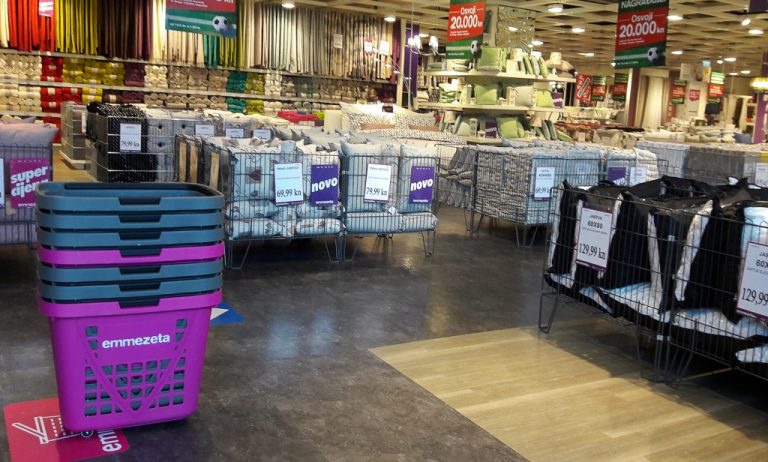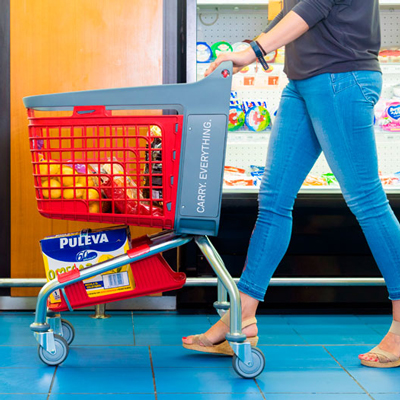

Most retail decisions revolve around assortment, promotions or layout. Those areas always grab the spotlight. Yet there is another element that every single customer interacts with from the moment they enter until the moment they leave: the shopping basket or cart they use to move through the store. It may look like a small operational detail, but it directly affects dwell time, comfort, navigation flow and ultimately sales.
That is why it is increasingly important to calculate the ROI of shopping baskets and carts in retail, even though this kind of assessment is rarely done in full.
Why this ROI is often missing from reports
Buying and operations teams deal with hundreds of daily variables, and baskets end up being treated as a simple commodity. They are cleaned, replaced and reordered when necessary. Their use is so routine that it is easy to overlook how much they affect the customer experience and the operational costs of a store.
But when a chain stops to measure these factors, it often discovers that the ROI of a basket or cart is far higher than expected.

1. The impact on dwell time: the first indicator of retail profitability
The time a customer spends in the store has a direct effect on the average basket value. A comfortable, stable, easy to handle basket allows shoppers to explore more sections without fatigue. A heavy or uncomfortable one has the opposite effect and accelerates the visit.
Across several European chains, improvements in ergonomics have been linked to higher dwell time, with increases ranging from 8% to 12%. Those extra minutes translate into real sales gains, especially in impulse categories.
2. Perceived comfort: the variable that silently changes the shopping route
No customer will tell you that a certain basket makes them walk faster or slower, but you can see it by observing behaviour. How they hold the basket, whether they switch hands frequently, or if they slow down in narrow aisles.
Comfort depends on details such as:
- how the handle behaves when walking
- whether the basket vibrates or stays balanced
- the noise of the plastic
- side-to-side movement
- friction against clothes or the leg
When these elements are well designed, the basket stops being an object the shopper must “manage” and becomes an invisible support. That is the ideal scenario for a smooth in-store experience.
3. Useful capacity: a key factor when calculating the ROI of retail baskets
Match 86L as a functional design example
Technical sheets focus on litres, but litres alone do not tell the full story. Two baskets with similar volume can behave very differently depending on their internal geometry.
The horizontal Match 86L basket, the largest in its category, is a clear example. Beyond its size, its straight walls allow large and bulky items to fit inside without the restrictions caused by inward-sloping sides. This makes a substantial difference in home goods, bazaar, drugstore and any section with oversized products.
A well designed useful capacity delays the moment when shoppers feel they are “carrying too much already”, which directly leads to more items added and a higher average ticket.
You can explore the case study where functional design created a measurable impact for a major home retail chain.

4. Aisle flow: when the basket prevents bottlenecks
Bond, XXL and Snupy as examples of capacity without added width
Aisle flow matters as much as product variety. In one metre aisles, two customers plus two baskets often cause small stops that break the rhythm of the visit.
Baskets with high capacity and a narrow footprint, such as Bond, XXL or Snupy, allow two people to move side by side with no awkward manoeuvres. This generates a smoother experience, less social friction and a greater sense of space even without modifying store furniture.
This improved flow has a direct impact on sales because shoppers spend more time in areas they would normally rush through.
5. Durability: essential when calculating the real ROI
Great, Bond and SuperBond as TCO references
The purchase price is only one part of the equation. To calculate the real ROI of baskets and carts in retail, the life cycle must be considered.
Three factors determine durability:
- material quality
- wall thickness
- monobloc construction or not
The Great hand basket combines light weight with outstanding resistance, reducing breakage in high traffic stores.
Monobloc baskets such as Bond or SuperBond go even further. Since they are made from a single solid piece with no joints, they eliminate structural weak points. This design minimises breakage and dramatically reduces the cost of replacement.
For large chains, the difference can add up to thousands of euros per year.
6. Early abandonment: the invisible boundary that reduces the average ticket
The basket sets the psychological pace of the purchase. When it looks full, even if there is still space left, the customer tends to assume the mission is complete. This threshold depends on both useful capacity and the effort required to carry or roll the basket.
That is why the model must be chosen according to the store format:
- convenience
- supermarket
- home and bazaar
- fashion
- DIY stores
- stores with online picking
- and others
The type of customer, the mission of the visit and the typical basket composition should guide the choice.
7. Operational productivity: when the basket improves internal efficiency
ReBasket and ROI in fulfilment and picking
Baskets are not only for shoppers. In many stores, they are work tools for staff.
ReBasket was developed precisely for this purpose. Its design reduces product breakage during picking, makes cleaning easier, optimises stacking and is engineered so that three units fit into standard backroom containers, improving space efficiency. In stores with heavy order preparation, these seconds saved per task become hours of productivity at the end of the month.
This type of improvement also forms part of the ROI, even if it rarely appears in analytical reports.
Conclusion: ROI lives in the details
To truly calculate the ROI of shopping baskets and carts in retail, it is necessary to look beyond the unit cost. Profitability can be found in:
- the comfort they provide
- the extra dwell time they encourage
- the reduction of early abandonment
- the fluidity of the in-store journey
- the real durability of the product
- the efficiency they bring to staff operat
When all these factors are considered together, the basket stops being an operational expense and becomes a quiet but powerful driver of sales and reduced costs.
 Become a newsletter subscriber and be among the first to read our new articles!