How to Choose Shopping Basket Capacity Using UPT and Shopping Behaviour
When shoppers have more room to add products, a comfortable, higher-capacity basket can encourage them to continue browsing and create more opportunities to increase units per transaction.
In stores already using medium-capacity baskets, moving to a larger, ergonomic model can create opportunities for higher sales. Visible space remaining in the basket can reinforce the shopper’s perception that there is room for more products, while easier handling keeps attention on the merchandise rather than on carrying it.
To choose correctly, it is useful to assess UPT, average transaction value, product volume, weight, journey duration and actual in-store shopping behaviour.
Choosing the capacity of a shopping basket can look like a purely functional decision. In practice, its implications go well beyond the number of litres.
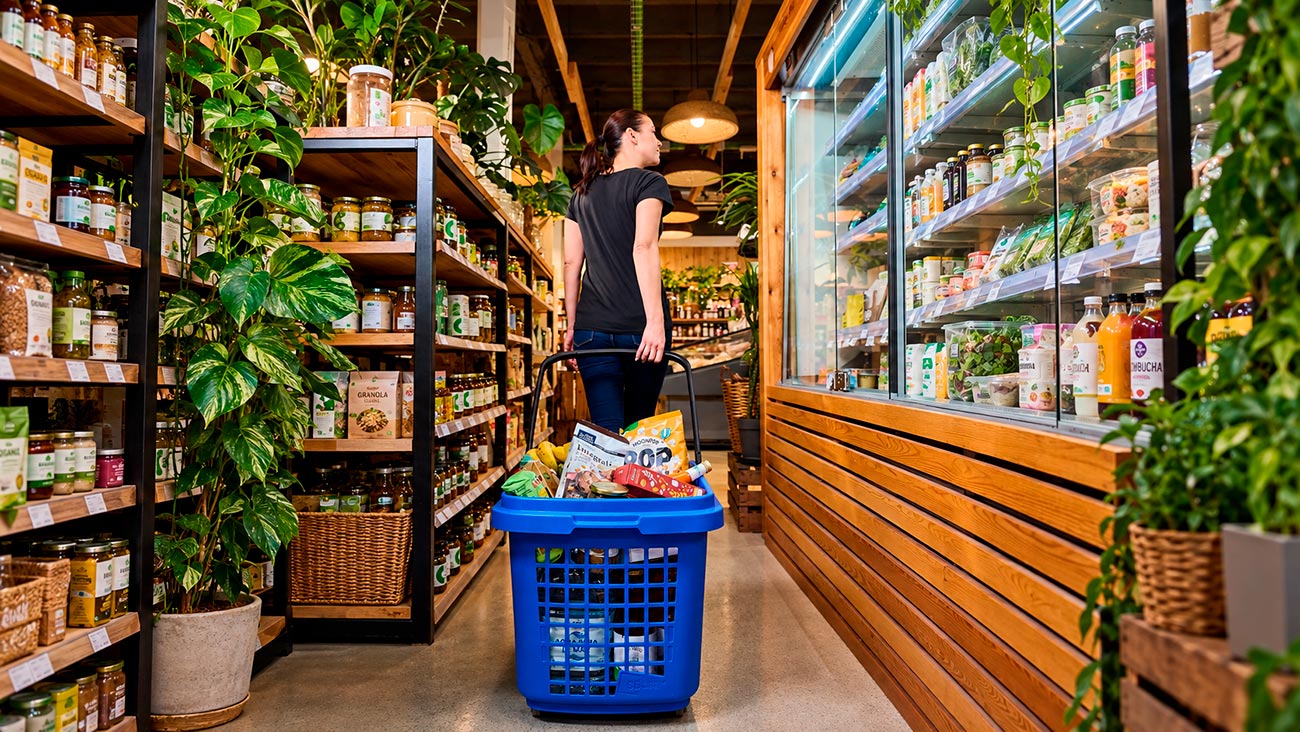
Where stores already provide medium-capacity baskets, moving to a larger format can give shoppers more freedom to add items as they browse. Smooth-rolling wheels and practical handles make that additional capacity comfortable to use.
The opportunity is to combine more usable capacity with better ergonomics, so customers can focus on discovering products rather than managing the weight or space available in their basket.
1. Shopping basket capacity and buying behaviour: what is the relationship?
The equipment customers use forms part of their physical experience inside the store.
As the basket fills up, there is less space available for additional products. With a hand basket, the weight the customer has to carry also increases.
When a medium-sized basket starts to fill up, shoppers can feel that their purchase is approaching its limit. A higher-capacity basket leaves visible room for additional products. Combined with easy manoeuvrability, it can help shoppers browse for longer and create more opportunities for additional purchases.
| What happens during the shop | What it may indicate | What to review |
|---|---|---|
| The basket is full before the customer finishes shopping | The current capacity may be insufficient for part of the store’s purchasing pattern. | Capacity and basket format. |
| The customer carries items outside the basket | The available space no longer matches the volume of the purchase. | Usable capacity and internal geometry. |
| The basket becomes heavy to carry | The issue may not only be litres, but also ergonomics. | Hand basket versus rolling solution. |
| The customer switches to a trolley during the shop | There may be a gap between the existing basket and the trolley. | Intermediate rolling solutions. |
| Products protrude or are difficult to place | The internal geometry may not match the product assortment. | Shape, base, side walls and internal dimensions. |
The perceived space left in a basket matters: when customers see they still have room, they may be more inclined to continue picking up products. An ergonomic shape, comfortable handles and smooth-running wheels can make the journey less tiring, helping customers spend more time exploring the store and making the experience more pleasant. This is a commercial opportunity to validate through store-level UPT and average transaction value data.
A larger, easy-to-manoeuvre basket gives shoppers room to continue adding products and reduces the effort of transporting purchases around the store.
2. What is UPT and what can it tell you about basket capacity?
UPT (Units Per Transaction) indicates the average number of units purchased in each transaction.
It is a useful metric for understanding how many items are typically included in a purchase, but it should not be used on its own to determine shopping basket capacity.
| Data point | What it helps you understand | What it does not tell you on its own |
|---|---|---|
| UPT | How many units are normally included in a transaction. | The actual volume or weight of those units. |
| Average transaction value | The average monetary value of a transaction. | How many products the customer buys or how much space they occupy. |
| Product volume | The physical space required to carry the products. | The accumulated weight during the shop. |
| Weight | The point at which a hand basket may start to become uncomfortable. | Whether the available internal space is sufficient. |
| Journey duration | How long the customer has to carry or move the basket. | The required capacity on its own. |
Two stores can have exactly the same UPT and still require completely different shopping baskets.
Ten small beauty products do not require the same amount of space as ten shoe boxes, ten bulky garments or ten grocery items with a high combined weight.
That is why it is more useful to work with several variables together:
UPT + volume + weight + shopping journey duration + store format.
3. Average transaction value: useful, but not enough
Average transaction value can also help you understand the purchasing pattern, but it needs to be interpreted carefully.
A high average transaction value may come from one or two expensive items. In that situation, a high-capacity basket may not be relevant.
Equally, a lower-value transaction may contain many low-cost products and require considerably more physical space.
For that reason, it is more useful to combine:
Together, these measures provide a better indication of how much physical space the customer actually needs during the shopping journey.
4. How can you tell when your current basket is becoming too small?
Before replacing a basket fleet, it is worth observing how customers actually use the current equipment.
- Do baskets regularly reach the checkout completely full?
- Do products extend above the rim?
- Do customers carry additional products in their hands?
- Do they switch from a basket to a trolley part-way through the shop?
- Are trolleys being used for purchases that are still relatively small?
- Are certain product types difficult to fit into the basket?
- Has the number of items per transaction increased?
- Does the basket become uncomfortable to carry before it is actually full?
These recurring signs are useful reasons to test a larger-capacity or more ergonomic basket in the store.
However, if they appear repeatedly, it is worth reviewing capacity, ergonomics, geometry and mobility.
5. What data do you need to size basket capacity?
Before comparing specific models, start with information about real shopping behaviour.
| Variable | Question to answer |
|---|---|
| UPT | How many items does a typical purchase contain? |
| Average transaction value | What type of transaction is most common, and what sort of journey usually goes with it? |
| Volume | How much space do the purchased products actually occupy? |
| Weight | At what point does carrying the purchase by hand become uncomfortable? |
| Duration | How long does the customer use the basket for? |
| Space | What basket dimensions can move comfortably through the store? |
| Observation | How do customers actually use the baskets and trolleys available? |
6. How to translate shopping data into a capacity requirement
Small shop
Few units, low weight, compact products and a relatively short shopping journey.
Consider: a compact hand basket.
Medium shop
More items, products accumulating during the journey and a load that is still manageable.
Consider: a larger hand basket or a compact rolling basket.
Medium-to-large shop
Higher volume, greater weight and a hand basket that starts to become full or uncomfortable.
Consider: a medium- or high-capacity rolling basket.
Large or bulky shop
High item count, bulky products or a longer shopping journey.
Consider: a high-capacity basket, a vertical solution or a trolley, depending on space and product type.
7. Initial guidance by capacity
Capacity ranges help retailers identify when a move from a medium-capacity basket to a more spacious solution could support additional purchases and improve the shopping journey.
Very small purchases
Few units, compact products and quick shopping journeys. Examples: Sweet 10L or Delux 12L.
Quick or medium-sized shops
More items without moving into a high-volume purchase. Examples: FIT 26L or RB32 32L.
Medium-to-large purchases
Higher volume and a growing need to reduce physical effort. Examples: Barcelona 54L or Bond 70L.
High-volume purchases
Larger purchases or bulky products. Examples: XXL 80L, Match 86L or Superbond 91L.
Important: two stores with the same UPT can require very different capacities. Product size, weight and geometry can completely change the amount of usable space required.
8. Capacity and basket format should be assessed together
Choosing the right number of litres is only part of the decision. The same capacity can behave very differently depending on the format.
Hand basket
A hand basket may be suitable for quick purchases and shorter journeys. Its main advantage is simplicity, but comfort can decrease as the load becomes heavier.
Horizontal rolling basket
A horizontal rolling basket allows customers to carry more volume while reducing physical effort.
It can be particularly useful when the typical purchase frequently exceeds the practical limits of a hand basket but does not necessarily justify a full-size trolley.
Vertical rolling basket
A vertical format can concentrate high capacity within a relatively contained footprint.
It can be especially useful where the store needs to combine capacity, mobility and efficient use of available floor space.
9. The right capacity also depends on the type of store
| Retail sector | Particularly relevant variables |
|---|---|
| Fashion | Garment volume, shopping journey duration, fitting rooms and circulation space. |
| Supermarkets and food retail | UPT, accumulated weight, volume and how the shop grows throughout the journey. |
| Sporting goods | Wide variation between small accessories and bulky products. |
| Beauty and drugstores | Number of small references and ease of handling. |
| Home, DIY and non-food | Dimensions, geometry and irregular product shapes. |
The sector provides context, but real in-store shopping data should validate the decision.
10. Higher capacity also has operational implications
Increasing basket capacity can improve the shopper’s experience while also changing how baskets are stored, moved and managed in the store.
- space required to store and stack baskets;
- movement through aisles and checkout areas;
- redistribution of baskets during the trading day;
- compatibility with fixtures and circulation areas;
- space available in fitting rooms;
- cleaning and maintenance;
- performance of wheels, handles and structure under intensive use.
Capacity therefore needs to work not only for the customer, but also for Operations, Store Concept and Procurement.
11. How greater capacity and ergonomics can support sales
For retailers already using medium-capacity baskets, a move to a larger ergonomic solution can encourage shoppers to add more products while keeping their shopping journey comfortable.
Insufficient capacity
It can restrict available space, reduce comfort and create friction before the customer reaches the checkout.
Store layout and basket handling
A larger format should be integrated into the store layout, with aisle width, stacking and manoeuvrability considered alongside the additional shopping capacity.
Extra capacity is most valuable when shoppers can use it comfortably. The combination of space, mobility and ergonomics helps keep their attention on products throughout the visit.
From theoretical capacity to a real in-store decision
Choosing a higher-capacity basket is not simply a question of adding more litres. Product type, customer journey, comfort and shopping behaviour all need to be considered together.
Explore a real XXL basket implementation in fashion retail and see how the need for a higher-capacity solution was addressed in-store.
View the Case Study →Capacity is a purchasing decision, but also an experience and operational decision
Basket capacity is both a technical specification and an opportunity to influence buying behaviour. In stores using medium-capacity baskets, offering a larger, easier-to-handle format can leave shoppers with a sense of available space, encourage product discovery and support additional items per transaction.
It can affect how the customer moves around the store, how much weight they carry, how easily they continue adding products and the point at which the equipment itself starts to become restrictive.
Before selecting a capacity, it is therefore useful to assess UPT, average transaction value, product dimensions, weight, shopping journey duration, available space and real customer behaviour.
Offering a mix of basket capacities can also make it easier to serve different shopping missions within the same store.
In some retail formats, the most practical solution may be to combine several capacities to support different shopping missions.
Frequently asked questions about shopping basket capacity and UPT
Does a larger shopping basket increase average transaction value?
In stores already using medium-capacity baskets, increasing capacity can favour additional purchases: shoppers can see space for more products, while an ergonomic wheeled basket makes it easier to continue browsing. The effect on average transaction value should be assessed using store sales data.
What it can do is prevent lack of space or excessive weight from becoming a physical limitation before the customer has finished shopping.
What does UPT mean in retail?
UPT stands for Units Per Transaction and represents the average number of units purchased in each transaction.
It is calculated by dividing the number of units sold by the number of transactions.
Can you choose a shopping basket based on UPT alone?
No. UPT should be analysed together with product volume, weight and dimensions, shopping journey duration and the available space in the store.
When should a retailer move from hand baskets to rolling baskets?
It is worth assessing when accumulated weight, volume or shopping journey length make carrying the purchase uncomfortable before the customer reaches the checkout.
Does more capacity in litres always mean more usable space?
Not necessarily. Internal geometry also matters. Side-wall shape, base design and internal dimensions determine how much of the stated capacity can actually be used with the products sold in the store.
More information to help define your in-store shopping equipment:
→ How to choose a shopping basket
→ Which shopping basket to choose for your store type
→ Explore shopping baskets for stores