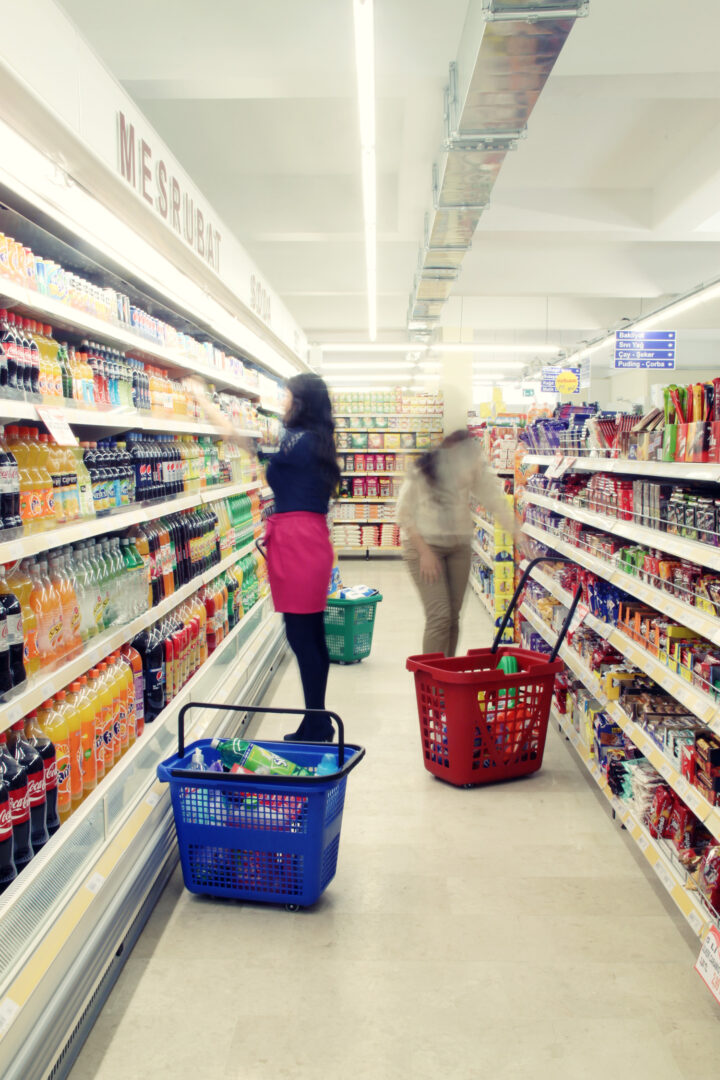
How to calculate the ROI of shopping baskets and carts in retail
The impact of baskets and carts goes well beyond unit cost. Dwell time, average basket value, durability and operational efficiency are the factors that determine the real return on store equipment.
The ROI of shopping baskets and carts in retail includes the impact on dwell time, average basket value, aisle flow, breakage reduction and staff efficiency. SB Shopping Basket manufactures in Spain hand baskets, rolling baskets and carts with monobloc construction, silent polyurethane wheels with double ball bearings and capacities from 10 to 91 litres. A range designed to maximise ROI in supermarkets, hypermarkets, home stores, DIY retail and picking operations. ISO 9001 certified, supply to more than 70 countries.
Most retail decisions are made with range, promotions or layout in mind. Yet there is one element that accompanies every customer from the moment they walk in to the moment they leave: the basket or cart they use to move around the store. It may seem like a minor detail, but it directly influences dwell time, comfort, aisle flow and, ultimately, sales. That is why it is worth calculating the ROI of shopping baskets and carts in retail, even though it is an analysis that is rarely carried out in full.
Why this ROI is usually missing from reports
Buying and operations teams work with thousands of variables, and baskets tend to be treated as a simple accessory. They get restocked, cleaned and replaced when needed. Their use is so routine that it is hard to see how much they affect the shopping experience and operational costs.
But when a chain stops to measure these factors, it discovers that the ROI of a basket or cart can be surprisingly high.

1. The impact on dwell time: the first profitability indicator
The time a customer spends in store directly influences the average basket value. A comfortable, stable and easy-to-handle basket lets the customer explore more sections without feeling tired. A heavy or uncomfortable basket does the opposite: it speeds up the purchase.
In several European chains it has been observed that an improvement in ergonomics leads to between 8% and 12% more time in store. These extra minutes have a real impact on sales, especially in impulse purchase categories.
2. Perceived comfort: the variable that changes the journey
No customer says “this basket makes me move faster”, but you notice it when you watch them. The way they hold it, whether they switch hands or slow down in narrow aisles.
Comfort depends on specific details:
- how the handle behaves while walking
- whether the basket vibrates or moves with the step
- the sound of the plastic
- lateral balance
- friction against the leg or clothing
When these elements are well resolved, the basket stops being an object and becomes an invisible support. That is the ideal.
3. Useful capacity: a key criterion for calculating ROI
Match 86L as an example of functional design
Data sheets talk about litres, but litres don’t tell the whole story. Two baskets with similar volume can behave completely differently depending on their internal geometry.
The horizontal Match 86L basket, the largest in its format, is the proof. Its size is substantial, yes, but an important feature is its straight walls, which allow large objects to be placed inside that simply don’t fit in slanted baskets. This makes a real difference in home, hardware, drugstore or any section with bulky products.
Well-designed useful capacity delays the feeling of “I’m already too loaded”, which translates directly into more items added and a higher ticket value.
A basket with straight walls and optimised interior geometry allows the customer to add more products before feeling overloaded. That margin becomes average basket value.
4. Aisle flow: when the basket prevents blockages
Bond, XXL and Snupy: capacity without taking up width
The flow of the journey matters as much as the range. In one-metre aisles, the combination of two customers and two baskets often creates small stops that break the rhythm.
Baskets with good capacity and a narrow design, such as Bond 70L, XXL 80L or Snupy 60L, allow two people to move in parallel without uncomfortable manoeuvres. The result is a more fluid experience, less social friction and a greater sense of space, even without changing the fixtures.
This flow has a direct impact on sales: customers spend more time in areas they would normally avoid.
5. Durability: an essential point for calculating real ROI
Great, Bond and Superbond as TCO benchmarks
The purchase price is only part of the cost. To calculate the real ROI, the lifecycle of the basket must be taken into account.
Three factors determine how long a basket lasts:
- type of plastic
- wall thickness
- whether it is monobloc or not
The Great 28L hand basket combines lightness and resistance, which reduces breakages in high-turnover stores. Monobloc baskets, such as Bond 70L or Superbond 91L, take this durability further: a single piece with no weak joints. This construction minimises breakages and drastically reduces restocking expenditure.
In large chains, this difference can amount to thousands of euros per year.
ROI factors and how SB Shopping Basket maximises each one
Each factor has a real impact on sales or costs. This table connects each factor with the most suitable SB product.
| ROI factor | Business impact | SB solution |
|---|---|---|
| Ergonomics and dwell time | Up to 12% more time in store, more impulse purchases | Fit 26L: ergonomic curve with 47% less effort. Rolling baskets with double ball-bearing wheels for smooth handling, even at full capacity. |
| Useful capacity and average basket value | Greater purchase volume before abandonment, higher ticket value | Match 86L: straight walls and maximum interior capacity. Superbond 91L: 91L in minimal footprint. |
| Aisle flow | Fewer blockages, more time in purchase areas, better experience | Bond 70L, XXL 80L and Snupy 60L: narrow design, two units side by side in a standard aisle. |
| Durability and total cost of ownership | Fewer replacements, less unplanned expenditure, lower TCO | Monobloc construction in Bond and Superbond. Great 28L: lightness and resistance for high-turnover retail. 2-year warranty. |
| Acoustic comfort in store | Better shopping experience, fewer complaints, higher perceived quality | Polyurethane wheels with double ball bearings across the full rolling range: maximum 28 decibels, 30% less noise than standard wheels. |
| Picking and click and collect productivity | Less time per order, fewer product breakages, more orders per hour | ReBasket 18L: 3 units in a standard eurocontainer, designed for picking, over 10,000 uses. |
| Supply and standardisation across stores | No stock-outs, consistent image, planned restocking | Manufacturing in Spain under ISO 9001 and ISO 28000. Planned supply for chains in more than 70 countries. |
6. Early abandonment: the invisible threshold that affects average basket value
The basket sets the psychological rhythm of the purchase. When it appears full even though space remains, the customer decides their mission is complete. That threshold depends as much on useful volume as on the effort required to move the basket.
That is why it is important to choose the right model for each store format:
- convenience
- supermarket
- home
- fashion
- DIY stores
- stores with online picking
Basket composition, shopping mission and customer profile should guide the choice.
7. Operational productivity: when the basket improves internal efficiency
ReBasket and ROI in fulfilment and picking
Baskets are not just for customers. They are also working tools for store teams.
ReBasket 18L was developed precisely for this context. Its design reduces product breakages during picking, makes cleaning easier and optimises stacking. It is designed so that three units fit inside standard eurocontainers, making the best use of available space. In stores with heavy order preparation, those seconds saved per basket add up to hours of productivity at the end of the month.
This type of improvement is a direct part of ROI, even if it rarely appears in reports.
Conclusion: ROI is in the details
To truly calculate the ROI of shopping baskets and carts in retail, you need to look beyond the unit cost. Profitability lies in:
- the comfort they offer
- the extra time they generate in store
- the reduction in early abandonment
- the flow of the journey
- real durability
- staff efficiency
When all these factors are analysed together, it becomes clear that a basket is not an operational expense. It is a tool that drives sales and reduces costs.
A basket is not an operational expense. It is a tool that drives sales, reduces costs and improves the customer experience on every store visit.
SB Shopping Basket manufactures shopping baskets and carts in Spain for retailers in more than 70 countries. Range from 10 to 91 litres, monobloc construction, polyurethane wheels with double ball bearings and planned supply under ISO 9001 and ISO 28000.
→ How to choose a shopping basket
→ View the full SB product range
→ Retail store optimisation
→ Shopping basket and cart manufacturers in Europe