What Type of Basket to Choose for Your Store
A practical guide for purchasing, operations, and retail management leaders who need to choose baskets and trolleys using real operational criteria: capacity, store format, durability, and total cost.
Quick answer
The right basket for each store depends on the format, the usual purchase volume, the available space, and the type of customer. SB Shopping Basket manufactures in Spain hand baskets, horizontal rolling baskets, vertical rolling baskets, and trolleys for retail, with capacities from 10 to 91 liters, designed for intensive use in supermarkets, convenience stores, perfumeries, DIY stores, and toy shops. The right choice reduces incidents, improves circulation in store, and lowers operating costs in the long run.
Choosing the type of basket for a store is not a minor purchasing decision. An unsuitable basket leads to breakage, hinders circulation, reduces average ticket size, and forces early replacement. A well-chosen basket, on the other hand, works without incidents for years, adapts to the available space, and improves the customer experience without requiring constant intervention. This guide organizes the criteria that really matter when making this decision based on data, not on price or habit.

Why basket choice affects in-store operations
A purchasing manager evaluating baskets usually compares the price per unit. That's a reasonable starting point, but an incomplete one. What doesn't show up in the initial budget is the cost of replacement when baskets break sooner than expected, the time staff spend removing damaged baskets, the degraded customer experience when no baskets are available at the entrance, or the noise of wheels in high-traffic stores that directly impacts the shopping atmosphere.
The type of basket also determines how much space it takes up at the store entrance, how customers flow through the aisles, and whether the customer can complete the intended purchase or abandons it early due to lack of capacity. All of these factors impact sales, operations, and the total cost of using the equipment.
A poorly chosen basket doesn't just cost more in the long run. It also reduces average ticket size, generates in-store incidents, and forces replacement ahead of schedule.
The four types of retail baskets and when to use each one
SB Shopping Basket manufactures four product families designed to cover different store formats, purchase volumes, and customer profiles. Understanding the differences between them is the first step toward making the right decision.
Hand basket
For quick purchases and establishments with limited space. Capacities from 10 to 28 liters. Ideal for pharmacies, perfumeries, convenience stores, and impulse-buy areas. Lightweight, easy to stack, and with a low replacement cost.

Horizontal rolling basket
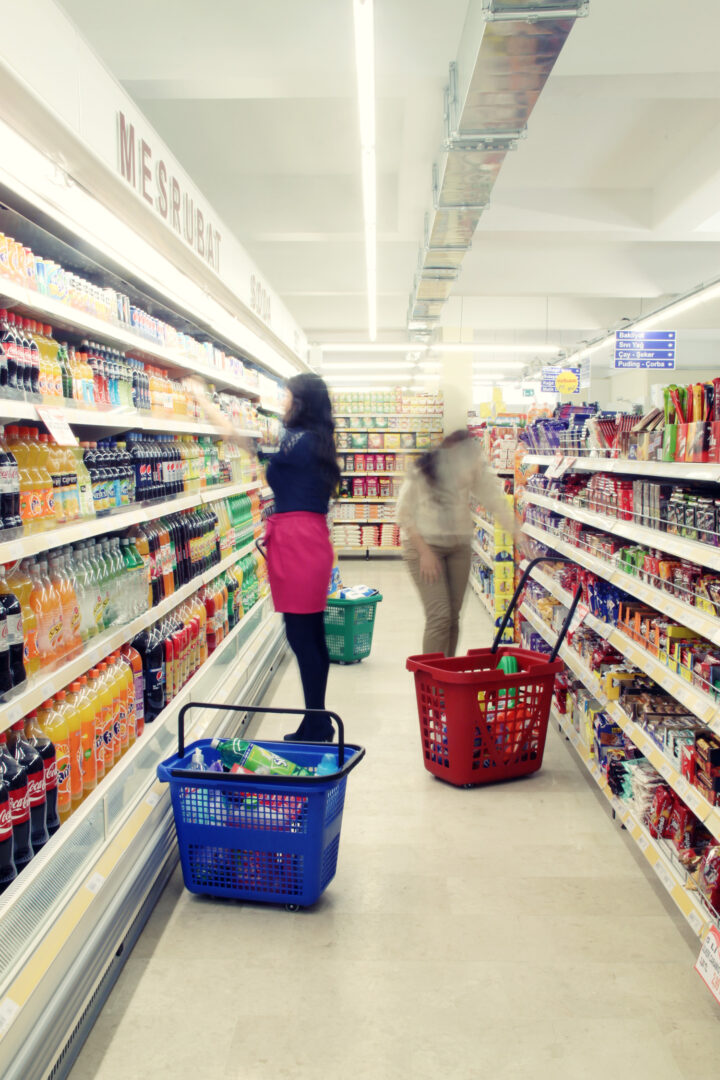
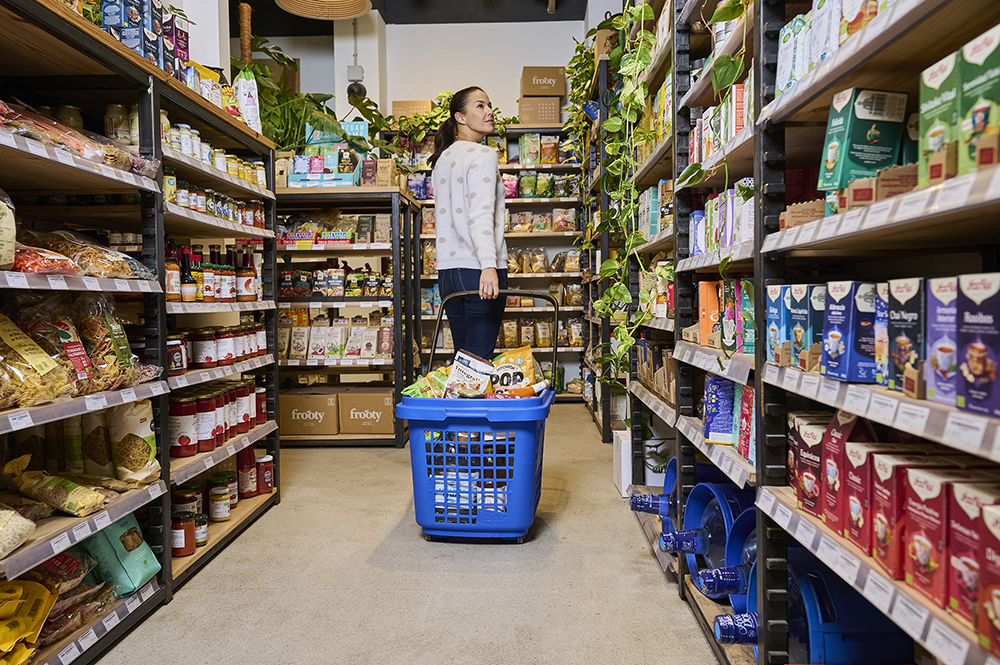
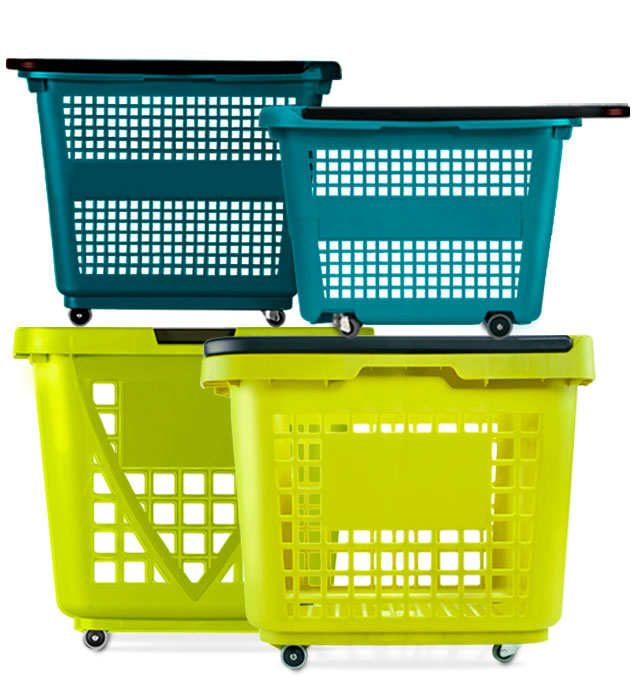
A format familiar to consumers, some with double handles, wheels of the highest quality with ball bearings. Capacities from 32 to 86 liters. Suitable for supermarkets, grocery stores, DIY stores, clothing, home goods, and many others. Good stability for varied and bulky products.
Vertical rolling basket
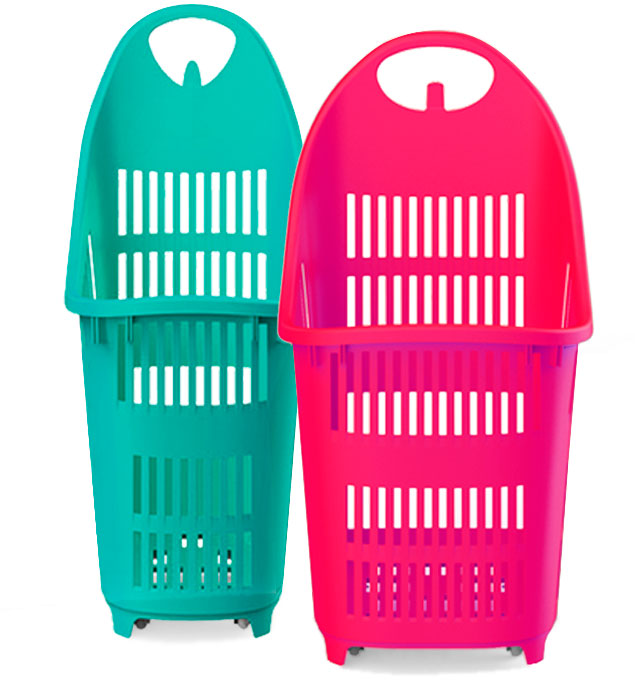
High capacity in a small storage footprint. Pull-or-push system and highly resistant monobloc construction. 70 and 91 liter models with optional brake. Designed for stores with ramps or escalators. Can replace a compact trolley with a lower investment.
Shopping trolley
For large purchases in hypermarkets, DIY stores, toy shops, and large retail spaces. Greater capacity and autonomy for the customer. Requires more store space but maximizes average ticket size in weekly or monthly purchase formats.
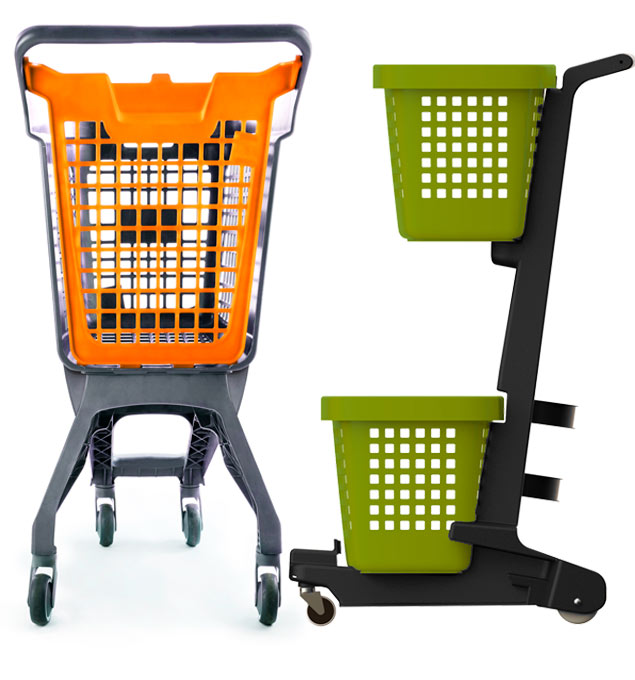
Decision matrix: which basket or trolley suits your store
The following table summarizes the main variables that determine which type of equipment best fits each store format. It's a good starting point for any selection process.
| If your store has... | Prioritize... | Recommended solution |
|---|---|---|
| Quick purchases and low ticket size | Lightness and ease of use | Hand basket 10-30L |
| Narrow aisles or limited space | Maneuverability and compact stacking | Vertical rolling basket 70L or UP80 compact trolley |
| High traffic and daily intensive use | Durability and resistant wheels | Heavy-duty rolling basket: see guide |
| Average purchase in supermarket or grocery store | Capacity and customer familiarity | Horizontal rolling basket 32-86L |
| Large purchase: DIY, toys, home | Maximum capacity and stability | Horizontal basket 80-86L or trolley |
| Ramps, escalators, or multiple floors | Brake and movement safety | Vertical basket with brake: SuperBond 91L or Bond 70L |
| Online picking or Click & Collect | Reusability, organization, and cost per order | ReBasket |
| Multi-store network or rollout across several countries | Stable supply and standardization | European manufacturer with planned production capacity |
| Fashion or textile store | Design, fitting room space, and capacity | Vertical basket 70-91L or horizontal basket 80-86L depending on format |
| Pharmacy or perfumery | Lightness, design, and customization | Hand basket 12-28L with color or logo customization |
Basket capacity and average ticket size: the relationship most overlooked
There is a direct relationship between basket capacity and the purchase volume a customer completes in store. A customer who fills their basket before finishing their route doesn't always ask for another one: in many cases, they simplify the purchase or abandon it altogether. A basket with insufficient capacity for the type of purchase typical of that store format acts as an unintended limiter on average ticket size.
This doesn't mean every store should use large baskets. A pharmacy with purchases of 3 or 4 products doesn't need a 54-liter basket. But an urban supermarket where the average customer shops for 3 or 4 days should avoid offering 20-liter hand baskets as the only option available.
The right capacity is the one that covers the customer's typical purchase volume for that format, leaving enough margin for the customer to add extra products without feeling the basket is full before reaching the checkout.
The right basket isn't the biggest or the cheapest. It's the one that matches the typical purchase volume of the customer in that specific store format.
Capacity guide by liters and type of establishment
| Capacity | Purchase profile | Type of establishment | SB products |
|---|---|---|---|
| 10 to 28 L | Quick purchase, few items | Pharmacy, perfumery, convenience store, kiosk | Hand baskets |
| 26 to 32 L | Average purchase, frequent restocking | Urban supermarket, drugstore, grocery store | RB32 32L |
| 32 to 54 L | Medium-large purchase, varied products | Supermarket, home goods, textiles, sports | Barcelona 54L |
| 60 to 91 L | Large purchase, bulky products | Hypermarket, DIY, toy stores, fashion | Bond 70L, XXL 80L, Match 86L, SuperBond 91L |
| ReBasket 18 L | Picking and Click & Collect | Dark store, pickup point, supermarket with online service | ReBasket |
What purchasing, operations, and management value when choosing baskets
In most retailers, the equipment decision involves three profiles with different criteria. Ignoring any one of them is the most common reason the selection process drags on or the purchase causes problems later.
Purchasing / Procurement
Price per unit, total cost of ownership, payment terms, delivery time, supplier certifications, and continuous supply capacity. The risk of changing suppliers and the manufacturer's reliability weigh as much as the initial price.
Operations
Durability under intensive use, wheel noise, ease of stacking, weight of the empty basket, handle strength, and real useful life. The problems caused by an unsuitable basket are managed by operations, not purchasing.
Management
Impact on customer experience, standardization across multi-store networks, brand image, total operating cost, and the ability to scale equipment to new openings without changing supplier or model.
Logistics / Supply chain
Lead time, ability to deliver in phases, flexibility for partial restocking, and proximity of the manufacturer. A European supplier reduces the risk of stockouts and response times in case of incidents.
The most common mistakes when choosing baskets for a store
Experience working with retail chains in more than 70 countries makes it possible to identify the mistakes that occur most frequently in equipment selection processes.
- Choosing based on initial price without calculating replacement cost. A cheaper basket that breaks within 18 months costs more than a higher-quality one that lasts 5 years.
- Not considering stacking space. A basket that takes up too much space at the entrance reduces available retail floor space and complicates daily restocking.
- Using the same model for every store format. A chain with urban supermarkets and large-format stores needs different solutions for each format.
- Ignoring wheel noise. In high-traffic stores, low-quality wheels generate a noise level that directly impacts the shopping experience and the perception of the store.
- Not planning for restocking. Changing models means having to live with two different basket types for years. Choosing a manufacturer with continuous supply capacity avoids this problem.
- Underestimating handle strength. Handles are the component most likely to fail under intensive use. A weak handle leads to incidents, complaints, and accelerated replacement costs.
The real cost of a basket isn't its price per unit. It's the price per unit plus the cost of breakage, replacements, in-store incidents, and the staff time spent managing them.
Why manufacturing in Europe changes the risk calculation
A European supplier isn't just a more expensive version of the same thing. It's a decision about where the operational risk lies when something goes wrong. A manufacturer in Spain with ISO 9001 and ISO 28000 certification can respond to an incident in days, not weeks. It can maintain safety stock for accounts with continuous supply agreements.
For a chain with stores in several countries, the difference between a European supplier and a distant one isn't just the cost of shipping. It's the ability to react when a store needs 200 replacement baskets within 10 days due to mass breakage. That kind of response isn't possible with a supplier 8,000 kilometers away and a 90-day lead time.
How to make the final decision
The process for selecting baskets for a store or a chain of stores should follow this order: first define the typical purchase profile of the customer for that format, then evaluate the available space at the entrance and in the aisles, then determine the necessary capacity and type of equipment, next compare the total cost of ownership between options, and finally verify the manufacturer's continuous supply capacity.
If the process starts with price and ends with price, the result is usually a purchase that causes problems within the first 12 months. If it starts with the store's real operational needs, the result is equipment that works without incidents and doesn't require constant attention.
SB Shopping Basket works with retail chains in more than 70 countries. If you need guidance on which solution best fits your store format, you can contact the sales team through the contact page.
The best basket for a store is the one that works day to day without causing problems, takes up the right amount of space, lasts as long as it should, and can be restocked without depending on a months-long delivery time.
Frequently asked questions
How many baskets does a store need?
It depends on the format, foot traffic, and the average time customers spend in store. A common starting rule is to have one basket for every 10 to 15 square meters of sales floor, but the right number is adjusted based on peak-hour visit volume and typical purchase type. A manufacturer with retail experience can help you calculate the optimal number for your format.
What's the difference between a hand basket and a rolling basket?
The hand basket is suitable for quick purchases with few items, has lower capacity, and doesn't require space for wheels or a tracking system. The rolling basket, horizontal or vertical, is designed for longer shopping trips where the customer needs to carry more volume without effort. The choice depends on the typical ticket size and purchase profile at each store.
How long does a basket last under intensive use?
A basket made with quality materials and designed for intensive use can last between 5 and 10 years under normal supermarket conditions. Lower-quality baskets tend to degrade within 18 to 36 months, especially at the handles and wheels. The most determining factor isn't the material in the abstract, but the design of the handle attachment point and the quality of the wheel bearings.
Can baskets be customized with the chain's logo or colors?
Yes. SB Shopping Basket offers customization through screen printing, pad printing, stickers, and IML (in-mold labeling) on various models. It's also possible to manufacture baskets in specific corporate colors for chains with sufficient order volume. The customization page covers the available options.
What is ReBasket and what type of store is it designed for?
The ReBasket is a reusable 18-liter basket designed specifically for picking and Click & Collect operations in retail. It replaces disposable packaging in online order preparation, reducing cost per order and waste generated. It's designed for supermarkets with home delivery or in-store pickup service, dark stores, and pickup points with high daily order volume.
What is the minimum order for SB Shopping Basket baskets?
The minimum order varies depending on the model and type of customization. To find out the terms that apply to your store format and estimated volume, the most direct way is to contact the sales team through the contact form.