Today we bring you the second part of the series of articles “Germs in the Retail World”. We want to explain the sanitation and hygiene challenges that supermarkets have to face.
In our first article, we create an explanatory glossary with all the terms that most resonate these days. If you have not read it yet, we invite you to take a look at it to have a clear perspective on this topic.
ANTIMICROBIAL COMMERCIAL EQUIPMENT
Supermarket baskets and carts
Over the last few years, many studies have been carried out in different countries. They study the quantity of germs in the retail world. Specifically the ones present in these commercial equipment goods.
All of them agree that the amount of pathogens present is much higher than recommended.
1. Study from the University of Arizona, USA – 2011
For this study, 85 carts from four different North American states were analyzed.
72% of these carts showed the presence of fecal bacteria. The two most commonly present bacteria turned out to be Escherichia coli and Klebsiella pneumoniae.
The conclusion of this study is that baskets and grocery carts can carry up to 10 million bacteria.

2. Study of the American company Reusethisbag.com
This study compares the amount of pathogens present in the carts of different types of supermarkets:
TRADITIONAL SUPERMARKETS

DISCOUNT SUPERMARKETS

LARGE SIZE SUPERMARKETS

UPSCALE SUPERMARKETS

Results
Microorganisms in traditional supermarkets

73 356 CFU/in²= x361 more bacteria
Microorganisms in bathroom knob

203 CFU/in²
Microorganisms in discount supermarkets

8 112 CFU/in² x270 = more bacteria
Microorganisms on the toilet flush button

30 CFU/in²
Microorganisms in large supermarkets

1 006 CFU/in² x3 = more bacteria
Microorganisms on the kitchen counter

361 CFU/in²
Microorganisms in upscale supermarkets

28 CFU/in² x1 = more bacteria
Microorganisms on the computer keyboard

23 CFU/in²
Microorganisms found
 Gram positive-rods (%)
In general, they are not very dangerous. They are very susceptible to antibiotics like penicillin. Besides, the human body produces an enzyme that directly attacks this type of bacteria.
 Negatif-gram rods (%)
In general, they are usually dangerous, since their outer layer is camouflaged and is more difficult to be detected by the human body. They can also cause serious infections and septic shock.
Yeasts (%)
Fungi can grow on the body even on the fingernails. It is usually associated with dermatological infections.
Bacillus (%)
Bacteria are associated with a variety of infections. They are usually food poisoning causing diarrhea and nausea.
Conclusions
75%
Carts with gram-negative bacteria are harmful to health.
24%
Carts with gram-positive bacteria are harmless to health.
1%
Carts with yeasts and bacillus that usually cause skin infections and food poisoning.
3. Study of three supermarkets in Las Palmas de Gran Canarias – 2018
For this study, the handles, baskets, and seats of children in 85 cars from seven different supermarkets were analyzed for three months.
Pathogens found:
- 12 carts infected with Klebsiella pneumoniae bacteria
- 6 carts infected with Citrobacter freundii bacteria
- 5 carts with Pseudomonas rhodesiae
- 4 carts infected with E. coli bacteria
- 3 carts with Pseudomonas fluorescens
Up to 80% of usual infections are thought to be caused by contact with contaminated surfaces. Many harmful microorganisms can survive on surfaces for hours and even days.
The contamination of supermarket carts comes from direct contact with the hands of many people and through direct contact with raw food.
Overall results
Handles
22 handles contaminated with coliforms
35 handles contaminated with Enterobacteriaceae
Child seats
43 seats contaminated with Enterobacteriaceae
3 seats with E.Coli
39 seats contaminated with coliforms
The results show much higher levels of pathogens than in public toilets, airports, or shopping centers.
The study concludes that a solution must be found to this extremely high number of bacteria present in carts. For this, they suggest daily disinfection, however, this is a utopia for many supermarkets. These do not have staff or space to perform these tasks daily.
SHOPPING BASKET’S SOLUTION

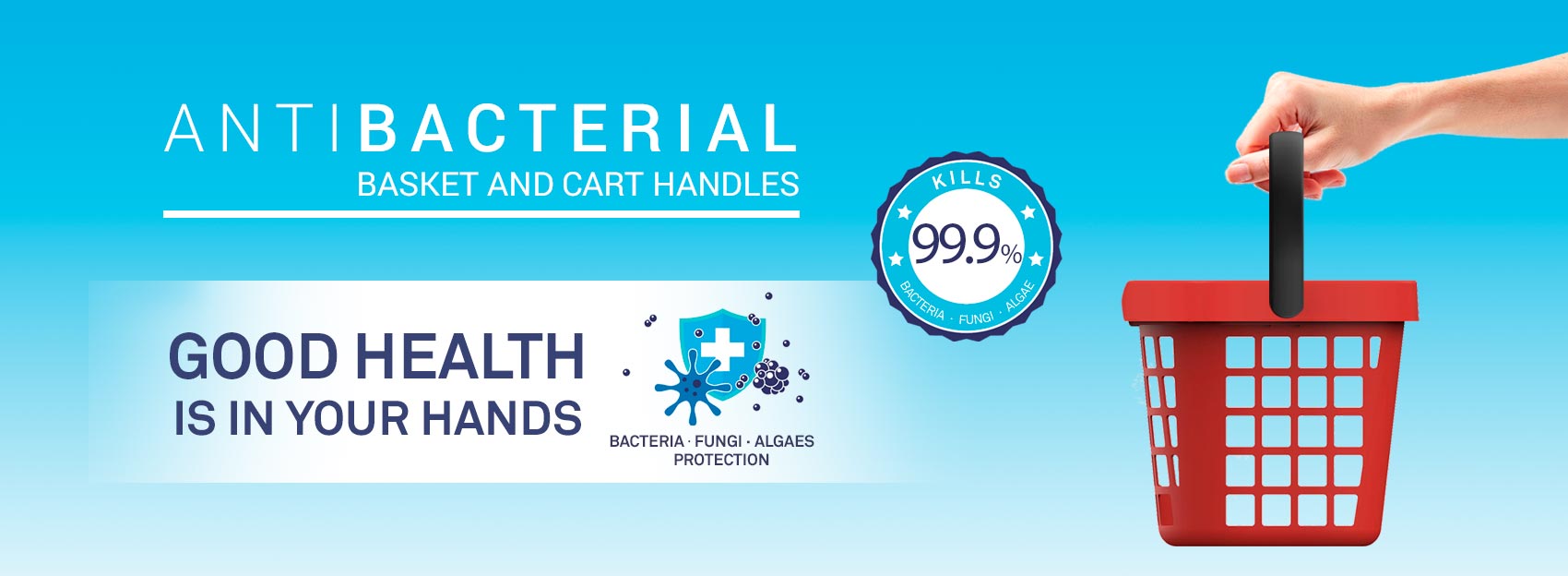
Shopping Basket has developed an effective, maintenance-free, affordable solution that kills 99.9% of the microorganisms that may be present in the handles of shopping carts and baskets.
With this solution, Shopping Basket presents to the market the safest shopping experience for your clients.
Advantages of antibacterial handles

24/7 active

Handle cleanliness even at a microscopic level

Elimination of possible odors caused by bacteria and fungi

It avoids stains produced by these organisms

It preserves the useful life of the plastic since these microorganisms cannot proliferate in the handles

Acts against a large number of pathogens
 Sign up for our newsletter and be the first to receive our articles!