Buyer vs Category Manager: who decides what when sourcing retail equipment?
Buyers and Category Managers may be involved in the same purchasing decision, but they assess suppliers, cost, product fit and risk from different perspectives. Understanding those differences is especially important when sourcing equipment for multiple retail stores.
Quick answer
The main difference between a Buyer and a Category Manager is the scope of the purchasing decision. A Buyer typically focuses on sourcing, commercial conditions, supplier reliability and purchasing execution. A Category Manager looks at how the solution fits the category, shopper needs and long-term commercial strategy. When sourcing retail equipment, both roles often need input from Operations and Supply Chain before a supplier can be properly evaluated.
Buying retail equipment is rarely a simple question of finding the lowest unit price.
A basket, trolley or other in-store solution may need to work across different store formats, withstand intensive use, remain available for future replacements and be delivered consistently throughout a rollout.
That means the Buyer and Category Manager may participate in the same project, but the questions they ask — and the risks they are responsible for reducing — are not the same.
Buyer vs Category Manager: the key differences
| Area | Buyer | Category Manager |
|---|---|---|
| Main focus | Purchasing execution and supply | Category performance and commercial fit |
| Supplier role | Sourcing, evaluation and negotiation | Strategic fit within the category |
| Price | Commercial conditions and purchasing cost | Impact on category economics and positioning |
| Product fit | Checks that purchasing requirements are met | Evaluates fit with the category and shopping mission |
| Supply risk | High involvement | Assesses business impact |
| Assortment | Supporting role | High involvement |
| Rollout | Commercial and supply feasibility | Fit with retail and category requirements |
| Time horizon | Contract, delivery and supply continuity | Medium- and long-term category performance |
The Buyer asks whether the supplier can deliver the right solution under the right commercial and supply conditions. The Category Manager asks whether that solution is right for the category and the shopper.
What should a retail Buyer evaluate beyond unit price?
Unit price is one of the most visible elements of a purchasing decision, but it does not describe the full operational impact of retail equipment.
Buyers also need to understand what happens after the first order: whether the supplier can maintain availability, whether replacements can be sourced efficiently and whether the same specification can be maintained throughout the project.
Supplier reliability
Can the supplier meet agreed requirements consistently across initial orders and future replenishment?
Delivery capacity
Can production and delivery volumes support the size and timing of the retail project?
Lead times
Are delivery times compatible with store openings, replacements and rollout schedules?
Consistency
Can the supplier maintain the required specifications across different batches and orders?
Future replenishment
Can additional units be supplied when stores expand, equipment is replaced or new locations open?
Total cost
What costs may appear after purchase through replacement, logistics, maintenance or operational handling?
What does the Category Manager evaluate?
The Category Manager brings a different perspective. The priority is not primarily how the purchase is executed, but whether the chosen solution fits the commercial environment in which it will be used.
In a retail equipment project, that can mean evaluating whether the capacity, format and use of the product are appropriate for the shopping mission and store concept.
Shopping mission
Does the equipment support the type and volume of purchase expected in the store?
Store format
Is the solution appropriate for the available space and the way customers move through the store?
Shopper experience
Does the equipment provide the capacity and usability customers need during their visit?
Category fit
Does the proposed solution support the broader commercial objectives of the format or category?
Who decides what in a retail equipment project?
Large retail purchasing decisions rarely depend on just one department. The roles involved may vary by organisation, but a typical project can require several perspectives.
| Decision | Buyer | Category Manager | Other teams |
|---|---|---|---|
| Supplier shortlist | High involvement | Input | Procurement |
| Commercial conditions | Lead | Input | Finance / Procurement |
| Product fit | Input | High involvement | Operations |
| Capacity and format | Input | High involvement | Store Concept / Operations |
| Operational durability | High involvement | Input | Operations |
| Rollout feasibility | High involvement | Input | Supply Chain |
| Supply continuity | High involvement | Business impact input | Supply Chain |
| Sustainability requirements | Input | Input | ESG / Compliance |
What should retailers evaluate when choosing an equipment supplier?
Comparing products is only part of supplier selection. For multi-store projects, retailers also need to understand whether the supplier can support the project throughout its lifecycle.
Product suitability
Does the proposed equipment fit the store format, expected shopping volume and operational requirements?
Supply reliability
Can the supplier support both the initial deployment and future replenishment?
Manufacturing consistency
Can product specifications remain consistent across different orders and phases of the project?
Scalability
Can supply adapt if the retailer adds stores, markets or further rollout phases?
Customisation
Can the supplier accommodate relevant branding, colour or configuration requirements when needed?
Lifecycle support
What happens when equipment needs to be replenished, replaced or standardised across the network?
Why the cheapest basket may not be the lowest-cost option
A lower purchase price can look attractive during a tender, but purchasing cost and total cost are not necessarily the same thing.
For equipment that is used every day, total cost may also be affected by replacement frequency, breakage, maintenance, internal handling, transport, replenishment and product continuity.
A meaningful comparison therefore needs to consider what happens during the full period of use, rather than evaluating suppliers on unit price alone.
The purchasing question is not only “How much does each unit cost?” It is also “What will this decision require from the business throughout the life of the equipment?”
For a deeper look at these costs, see our article on the hidden operational cost of shopping baskets and shopping trolleys .
Supplier risk becomes more important in multi-store rollouts
Supplier selection becomes more complex when equipment needs to be deployed across multiple stores, regions or markets.
A retailer may need to coordinate different delivery dates, store openings, future replacements and consistent specifications over time.
In this situation, supply capability becomes part of the purchasing decision itself.
Volume
Can the supplier support the required quantities within the planned rollout?
Phased deployment
Can deliveries be coordinated across different project phases or groups of stores?
Future openings
Can the same solution remain available as the store network evolves?
Replacement supply
How easily can individual stores obtain additional equipment later?
Example: sourcing shopping baskets for a retail chain
Imagine a retailer planning to replace shopping baskets across 150 stores.
Looking only at the product and unit price would leave several important questions unanswered.
| Role | Questions to consider |
|---|---|
| Buyer | What are the commercial conditions? What are the lead times? Can supply be phased? How will future replacements be managed? |
| Category Manager | Is the basket capacity right for the shopping mission? Does the format fit the store concept and expected shopper behaviour? |
| Operations | Is the equipment practical to use, stack, move, distribute and replace in everyday store operations? |
| Supply Chain | Can deliveries and future replenishment be coordinated efficiently across the network? |
When the supplier becomes an industrial partner
In larger retail projects, the supplier decision can go beyond purchasing a standard product.
Retailers may need consistent specifications, coordinated production, customised finishes, phased deliveries and future replenishment across an entire store network.
At that point, manufacturing capability and supply continuity become part of the purchasing criteria alongside product fit and commercial conditions.
This is particularly relevant when working with manufacturers of shopping baskets and trolleys on larger or long-term retail projects.
See a retail equipment decision in practice
Choosing retail equipment involves more than comparing unit prices. Capacity, store fit, shopper behaviour and the way the solution performs in a real retail environment all influence the outcome.
Download this SB case study to see how an 80L XXL rolling basket was used in a real retail project and explore the relationship between shopping capacity, customer experience and commercial performance.
Download the free case study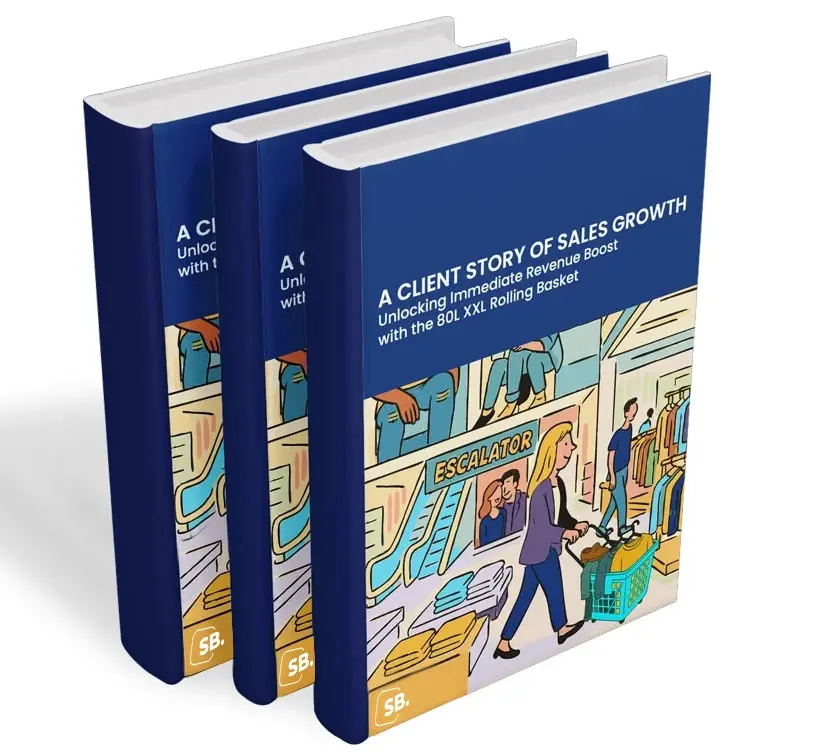
Frequently asked questions
What is the main difference between a Buyer and a Category Manager?
A Buyer typically focuses on sourcing, supplier negotiations, commercial conditions and purchasing execution. A Category Manager focuses on the performance of the category, including assortment, shopper needs and the strategic fit of products and suppliers.
Who chooses suppliers in retail?
The process depends on the organisation. Buyers and Procurement usually have significant responsibility for sourcing and commercial evaluation, while Category Management, Operations and other teams may contribute to product fit, performance and operational requirements.
Should retail equipment suppliers be compared only on price?
No. Price is important, but retailers may also need to consider product suitability, supply reliability, delivery capacity, consistency, replenishment and the costs generated throughout the equipment lifecycle.
Why is supplier capacity important in a multi-store rollout?
Because large retail projects may require coordinated volumes, phased deliveries, consistent product specifications and future replenishment across multiple stores or markets.
What should a Buyer consider when purchasing shopping baskets or trolleys?
The evaluation can include purchase price, supplier reliability, delivery times, total cost, replacement requirements, supply continuity and the supplier’s ability to support the planned rollout.