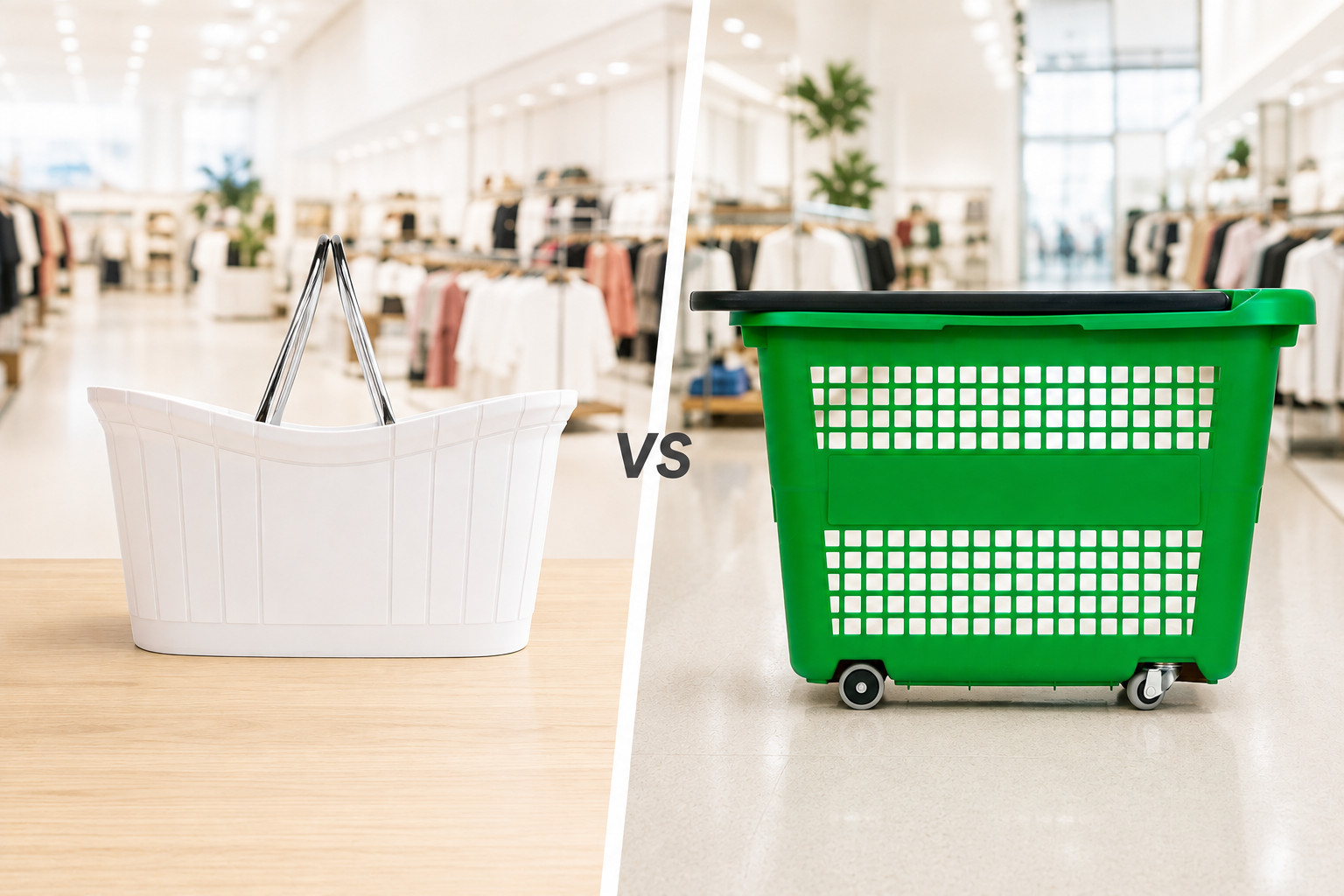
When to choose a hand basket, and when to choose a rolling basket
The difference isn’t just about the wheels: it’s about the moment weight starts to shape the customer’s shopping experience.
Hand baskets are the best option when shops are quick, light and involve only a few items, since they offer immediate access, agility and low maintenance cost. Rolling baskets are preferable when the trip is longer or the shopping volume increases, because they remove the effort of carrying weight and add comfort without needing a trolley.
It isn’t about one system replacing the other — it’s about identifying the point at which weight starts to shape how the customer shops.
For many years, the answer was simple: small shops meant a hand basket, big shops meant a trolley. But consumer behaviour has changed. Today, supermarket visits are more frequent, shops tend to be smaller, and more and more retail formats exist where a trolley is unnecessary, yet a traditional basket can fall short. That’s the context in which rolling baskets emerged — not to replace hand baskets, but to cover a type of shop that previously had no specific solution.

The difference isn’t in the wheels
Most people think the only difference between the two systems is the wheels. In reality, the difference runs much deeper. A hand basket is designed for shops where weight barely affects the customer’s experience. A rolling basket is designed so that weight stops being a problem at all. That small shift completely changes how the customer moves through the store.
How customer behaviour changes
Picture two customers who both walk in intending to buy five products: one uses a hand basket, the other a rolling basket. At first, the experience is almost identical, but as the number of items grows, differences start to appear.
The customer carrying a hand basket starts bearing more weight on a single arm, switches hands repeatedly, rests the basket on the floor while comparing products, or speeds up the trip to finish sooner. The customer using a rolling basket, on the other hand, barely notices that extra weight and can keep shopping comfortably throughout the whole visit. That doesn’t necessarily mean they’ll buy more — it means comfort stops being a limiting factor.
The real difference between a hand basket and a rolling basket isn’t the litres. It’s the point at which weight starts to affect the customer’s experience.
Effort is also part of the shopping experience
When people talk about customer experience, they usually think of store layout, service or signage. But ergonomics is part of that experience too: carrying six kilos for fifteen minutes doesn’t feel the same as rolling them along. Reducing that effort improves comfort throughout the visit, especially for older customers, families or people who shop frequently. That’s why many chains have gradually introduced rolling baskets even in stores that previously only offered traditional baskets.
What are the advantages of a hand basket?
Despite how retail has evolved, hand baskets remain the best solution in many formats. When shops are quick and involve only a few items, there’s hardly a more efficient solution.
- Immediate access right at the entrance.
- Maximum agility.
- Little storage space needed.
- Lower acquisition cost.
- Very simple maintenance.
- Easy to stack in large numbers.
Examples of SB hand baskets

Sweet
A compact basket for quick shops in perfumeries, pharmacies and specialty retail.
See Sweet 10L →
Delux
An elegant design for stores where appearance is also part of the shopping experience.
See Delux 12L →
What are the advantages of a rolling basket?
Wheels don’t just remove effort. They also make it possible to increase capacity without the customer feeling an excessive load. That’s why they’re common in neighbourhood supermarkets and chains where medium-sized shops are the norm.
- More comfort on longer trips.
- A better experience as weight increases.
- Higher capacity.
- Good manoeuvrability.
- Less need to reach for a trolley.
Examples of SB rolling baskets


Barcelona
One of the most representative rolling baskets in the SB range for supermarkets and grocery stores.
See Barcelona 54L →Hand basket or rolling basket: a quick comparison
This table sums up when each system makes the most sense, based on the type of shop and the store format.
| Criteria | Hand basket | Rolling basket |
|---|---|---|
| Type of shop | Quick, with few items | Medium-sized, or a longer trip |
| Perceived weight | Increases with the number of items | Barely noticeable throughout the trip |
| Storage space | Very small | Larger, needs more floor space |
| Acquisition cost | Lower | Higher than a hand basket |
| Recommended store format | Short trips, few products per visit | Neighbourhood supermarkets, medium shops |
| Customer profile that values it most | Express shopping | Older customers, families, frequent shoppers |
When isn’t a rolling basket worth it?
Not every store needs to add them. In some cases, a hand basket remains the best choice, for example:
- Stores where the average shop is very small.
- Establishments with trips under five minutes.
- Shops where most customers buy fewer than four items.
- Stores with very little available space.
Installing rolling baskets just because they’re a trend doesn’t always improve the customer experience. As with any retail equipment, the right solution depends on the context.
Common mistakes when comparing the two systems
One of the most frequent mistakes is thinking only about capacity. But litres and comfort don’t always mean the same thing. It’s also common to:
- Copy the system used by another chain.
- Assume wheels are a substitute for a trolley.
- Choose based on price alone.
- Skip observing how the customer actually shops.
The best decision usually emerges when the shopping behaviour is analysed first, and the equipment is chosen afterwards.
Five questions for a better decision
Before renewing the shopping system, it’s worth answering these questions:
- How many products does each customer buy on average?
- How long do they stay inside the store?
- At what point does carrying the shop start to feel uncomfortable?
- Is there enough space for a trolley fleet?
- What percentage of customers do quick shops?
These answers offer far more insight than comparing technical specifications alone.
Conclusion
If most shops are quick and light, a hand basket remains an excellent solution. If the trip is longer and shopping volume increases, rolling baskets bring a level of comfort that can improve the experience without needing a traditional trolley. Rather than choosing between two products, the decision comes down to identifying which one best supports the customer in how they usually shop.
Frequently asked questions
What’s the main difference between a hand basket and a rolling basket?
The main difference isn’t the wheels themselves, but the point at which weight starts to shape the customer’s experience: a hand basket works well as long as the weight is barely noticeable, while a rolling basket is designed so that weight stops being a problem.
Do rolling baskets replace the shopping trolley?
No. Rolling baskets weren’t created to replace the trolley, but to cover an in-between type of shop that previously had no specific solution: shops too large for a hand basket, but not large enough to justify a trolley.
Which stores should stick to hand baskets only?
Stores with very short trips, shops of fewer than four items, or very limited space usually work better with hand baskets alone, since installing rolling baskets in these cases doesn’t always improve the customer experience.
How can a store tell if it needs rolling baskets?
It helps to look at how many products each customer buys on average, how long they stay in the store, and at what point carrying the shop starts to feel uncomfortable. These answers guide the decision far better than comparing litre capacity alone.
SB Shopping Basket. Discover the full range of hand and rolling baskets for stores and supermarkets.
→ Find your ideal basket
→ Hand baskets
→ Rolling horizontal baskets