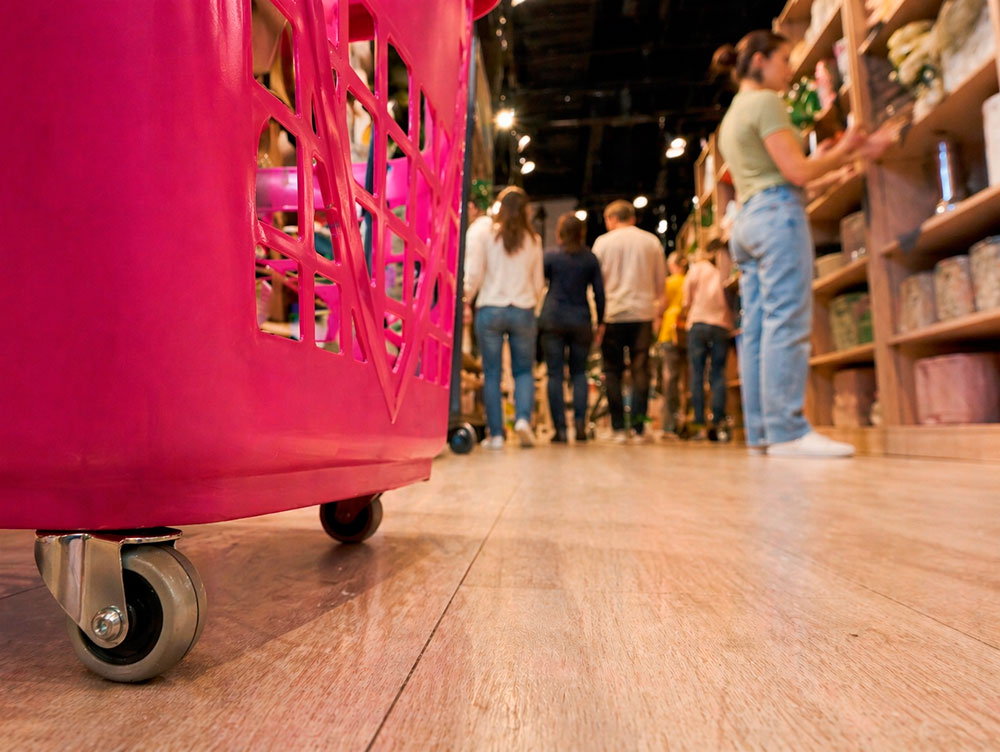
Why polyurethane wheels improve the experience in high-traffic stores
A practical guide for retailers that need to improve mobility, reduce noise and increase the durability of shopping baskets and carts in intensive-use environments.
In a high-traffic store, the wheels of a basket or cart are not a minor detail. They affect noise, mobility, product wear, customer comfort and the operational workload of the store team. Polyurethane wheels help shopping baskets and carts move more smoothly and with greater control, especially in supermarkets, urban stores and retail chains with intensive daily use.

When discussing retail equipment, it is easy to focus on capacity, colour, price or overall design. All of that matters. But in day-to-day store operations, small components can have a very visible impact. Wheels are one of them.
A wheel that makes noise, blocks, vibrates too much or wears out too early can affect the shopping experience and create internal incidents. The customer will not analyse it as a technical problem. They will simply notice that the basket does not move properly, that the cart is hard to push or that the journey through the store feels uncomfortable.
For operations, purchasing and management teams, basket and cart mobility matters because it directly affects the shopping experience and the operational workload in store.
Why wheels matter in retail
In supermarkets and high-traffic stores, rolling baskets and shopping carts are constantly moving. They circulate through aisles, entrance areas, checkout zones, fresh produce sections, smooth surfaces, rougher floors and areas with high customer density.
This repeated use requires wheels designed to work steadily over time. It is not only about making the basket move. It is about making it move well, without creating unnecessary problems.
A good wheel should provide
- Smooth movement.
- Stability throughout the journey.
- Low noise level.
- Resistance to wear.
- Good performance under load.
- Lower vibration during use.
- A sense of control for the customer.
In stores with many customers entering and leaving, any failure is multiplied. If a wheel performs poorly in one store, it may seem like an isolated incident. If it happens across dozens or hundreds of units, it becomes an operational issue.
What polyurethane wheels bring to shopping baskets and carts
Polyurethane is used in wheels because it combines resistance, grip and smoother rolling than many rigid materials. In shopping baskets and carts, this feature can help improve daily use in store.
Polyurethane wheels can reduce the feeling of impact, vibration or hard dragging while the product is moving. This is especially important in larger-capacity baskets, loaded carts or areas where customers make longer shopping journeys.
They can also improve acoustic perception. In a supermarket, noise does not only come from conversations, checkouts, replenishment activity or background music. The constant movement of carts and baskets also forms part of the store’s sound environment.
When equipment rolls better, the store feels more organized, more comfortable and easier to move through.
Noise, mobility and the shopping experience
The shopping experience does not depend only on assortment or price. It also depends on how the customer moves through the store.
A rolling basket that moves easily allows the customer to progress without effort, turn better in narrow aisles and continue shopping without discomfort. For medium-sized purchases, this can be especially relevant because the customer does not want to carry too much weight by hand, but may not need a large cart either.
At that point, the rolling basket has a very specific role: offering comfort without taking up as much space as a traditional cart. But for that role to work, the wheel must perform well. If the basket gets stuck, drifts or makes too much noise, the benefit disappears.
Impact on store operations
For the store team, low-quality wheels can create extra work. Units need to be removed, incidents checked, defective products separated or replenishment needs reported earlier than expected.
By contrast, a well-designed wheel system helps reduce small day-to-day interruptions. It does not eliminate every problem, but it contributes to more stable equipment performance.
This is important for retail chains that want to standardize their basket and cart fleet. If each store has different problems with mobility, noise or wear, operations lose control and purchasing has more difficulty evaluating the supplier’s real performance.
Fewer internal incidents
Suitable wheels reduce blocking, vibration, noise and early removal of defective units.
More operational stability
When mobility is consistent, purchasing and operations can maintain better control of the basket and cart fleet.
What retailers should evaluate before choosing rolling baskets
Before choosing baskets or carts for high-traffic stores, several mobility-related aspects should be reviewed.
Expected type of use
Not every store has the same level of circulation. An urban store, a neighbourhood supermarket and a hypermarket do not have the same needs. Equipment should adapt to customer volume, type of purchase and available space.
Performance under load
A basket may move well when empty, but perform worse when the customer fills it. That is why it is important to assess stability and rolling performance under real conditions of use.
Noise in store
Accumulated noise can affect the shopping atmosphere. In high-traffic stores, a quieter wheel can improve the overall perception of the space.
Resistance to wear
The wheel must withstand repeated movement, changes of direction, impacts, stacking and daily use. Component durability influences the service life of the entire product.
Supplier reliability
The product matters, but continuity also matters. Purchasing teams need to know that they will be able to replenish models, maintain references and work with a supplier capable of responding when the chain needs it.
A technical improvement with visible impact
Polyurethane wheels are not a decorative argument. They are a technical improvement that can directly affect mobility, noise, comfort and durability.
In retail, the best solutions are often the ones that do not draw attention because they simply work. The customer picks up the basket, moves it, shops and does not think about it. The store team does not have to remove it constantly. Purchasing does not receive repeated incidents. Operations maintains a stable standard.
That is what a retail chain should look for in its equipment: products designed for real use, prepared for high traffic and capable of working day after day without creating unnecessary problems.
Frequently asked questions about polyurethane wheels in baskets and carts
What advantages do polyurethane wheels offer in retail?
They provide smoother rolling, better movement control, lower vibration and a more comfortable experience when using shopping baskets and carts.
Are they suitable for high-traffic stores?
Yes. Polyurethane wheels are especially useful in environments with constant movement, where mobility, noise and wear are important factors.
Do they help reduce noise in store?
They can contribute to quieter rolling compared with more rigid materials, especially when used in baskets or carts designed for intensive use.
Why should purchasing teams evaluate the type of wheel?
Because the wheel influences product service life, customer experience, in-store incidents and the operational cost associated with retail equipment.